




Where competition, corruption, bias, injustice, and antitrust meet midwifery
Finally–some oversight and accountability. But will anyone read these emails or answer the phone calls? Only time will tell. I actually stumbled upon this info on the LSBME’s website, but the first time I saw it was in the email signature of my compliance officer in October 2018.
In compliance with Act 2018-655, the Board gives notice to its licensees and applicants of their opportunity to file a complaint about board actions and board procedures. You may submit such complaints to one or more of the following organizations:
1. Louisiana State Board of Medical Examiners; 630 Camp Street, New Orleans, LA 70130; (504) 568-6820; lsbme@lsbme.la.gov.
2. Committee on House & Governmental Affairs; La. House of Representatives; PO Box 44486, Baton Rouge, LA 70804; (225) 342-2403; h&ga@legis.la.gov
3. Committee on Senate & Governmental Affairs; La Senate; PO Box 94183, Baton Rouge, LA 70804; (225) 342-9845; s&g@legis.la.gov.
In the middle of this licensure purgatory, life goes on. Births are still happening. I have no choice but to continue waking up at night, put on my big girl panties (or a depends undergarment sometimes) and go hold space for those babies to enter the world. Oh and I occasionally get paid for this too.
Tonight I head to a birth where one of my good friends is the licensed midwife. I arrive to find that I am not really needed as an assistant there are two students also in attendance. It is common for midwives to have students attend births they need the hands-on experience and we need to keep replenishing the pool considering the burnout is high in this field. Likewise, most of us believe that we want future generations to benefit from having midwives so we need to make more constantly. Students frequently have varying schedules as they are by definition students so we get used to working around tests, school, and other issues. Tonight was no different. It was actually nice to not have to concentrate as hard. We had four brains tonight, which means an easy night right? hahahahahahahahahahaha
My roommate had been patiently waiting for me to come home that day. I was going to pick up dinner, but for some reason, after watching this mother labor intensely in the bathtub, I hesitated. I don’t like calling this feeling intuition, but you could. To me it was just a hesitation, but an important one. About ten minutes before the birth, I decided that I was not going to leave until the baby was born even though I had been waiting nearly two hours thinking the baby would have arrived and I would be on my way.
First babies do all the hard work of “paving the road” so-to-speak. The mother’s pelvic ligaments and tissues get stretched and the body does an excellent job of remembering what birth looks like replicating it well provided huge changes haven’t been made. If the mom took up cross-fit during the pregnancy anything is game as far as muscle relaxation goes during second stage. That said, subsequent births are usually much faster and easier especially once the baby enters the vaginal canal. This baby had been down in the canal a while. Sometimes this is normal, sometimes not. Usually it can be caused from a crooked head, or a hand by the baby’s face, or the baby may be bigger than the previous ones.
This mom had an epidural with her first baby, but otherwise no red flags. her first baby was around 7 lbs. Seems normal for her and her partner’s small frames and ethnicity. As we move from the bathtub to the bed to assess progress of baby’s descent, the mom assumes a hands and knees position for the impending delivery. The midwife was on queen-size bed behind the mom and one student was beside her. The other student was behind them charting and keeping time. Its a good time to note that this charting student had mentioned earlier in the day that she has yet to see a true emergency. Sigh. She has been a student for over a year and every birth apparently has been routine and normal. Not that all emergencies can be predicted, because otherwise they wouldn’t be called emergencies.
Being at home, we can provide a vastly different environment than hospitals. Lights are usually off or dim, the air temperature is warmer, it smells like home or essential oils or whatever your support team puts in the oven. You are wearing what you want and relaxed. No one is touching you or yelling. Except during an emergency when we throw on the lights, and begin using what I call our midwife voices. We may ask the support team to help or leave room. You may not have your baby in the position you thought you would.
As I rounded the end of the bed focusing on the ever-so inching of the baby’s head out of the mother, I noticed it looked darker than normal. Hmmmm. Was this because of the parent’s ethnicity? or a perfusion issue? The sun had set providing just enough light through the windows to make out what was going on, but not enough to not cast doubt. I quickly hit my phone’s flashlight function and shined it on the baby’s head. Oh bleep.
I made eye contact with the midwife and we synced our thought processes. Sounds funny, but this happens often when you get used to working with the same midwives. We both knew what to do. We needed to move the mother if the baby couldn’t make the journey through the canal on its own. What was going on? The head had been born but it was losing color, meaning it was not being perfused by the cord anymore. While heart tones had been good right before crowning, this color was anything but. The midwife frantically searched behind the head for sometimes blocking the decent of the body. She couldn’t find a reason. Was it a shoulder or an arm? The student and I quickly got the mother into a runner’s start position. If it is a true shoulder hung up on the pubic bone (what most doctor’s are terrified of) this one move usually helps dislodge the shoulder as it is able to rotate around the pubic bone. The midwife was still encouraging the mother to push through the next contraction. The charting student had turned on the lights. Nothing budged. We continued to flip and move the mother over and on to her back to have better access to her pubic bone and the baby. With this change in position, the baby descended enough for the midwife to grab a hold of a tight cord. She said it twice. The student on the bed reached for the instruments to clamp and cut the cord on the perineum, something we don’t normally do unless in an emergency. Luckily, this little one began budging before the instruments were employed. With one strong surge from the mother and some traction from the midwife this baby was born. After further untangling this little guy, we just needed to stimulate him to breathe–normal for a stalled arrival. He was in his mother’s arms in minutes.
Why didn’t we call 911? Well, if after moving the mother we had not had any movement of the baby, we would have. But we are trained to handle these emergencies. We are trained to do as much as we can until we can’t anymore. We don’t give up until we get a baby out or transport, whichever comes first. We use our intuition, brains, and a combination of years of gene selection, evolution, physiology, physics, herbs, oils, and biology. It is only vary rarely that we use actual medicine. This is why midwifery is nothing like modern day obstetrics and I am glad it isn’t.
Though I previously submitted an application for Florida licensure while literally in the middle of my Louisiana investigation, my application was denied and I let the dream of being a midwife in Florida go until June 2018. I once again inquired on why I was denied licensure and found out that it was questionably legal as to how the department of health denied me the first time. The new person in charge of Florida’s midwifery licensure seemed perplexed and all but encouraged me to reapply seeing that I had now graduated from an in-state midwifery school and completed all of the state’s rigid requirements for licensure. My letter to the Florida Council of Midwifery/Dept of Health is below. It also includes an explanation of everything Louisiana believed I violated in my Board Order, but does not include any attachments.
Addendum June 9, 2018
Dear Florida Council of Licensed Midwifery,
For the last three years, I have been working towards fulfilling the sanctions required by Louisiana for a suspension of my midwifery license. However, I had to complete the required sanctions sporadically as I was providing hospice care for my grandmother, until she passed away in October 2017. In the next few paragraphs, I will describe my quest to fulfill the sanctions of a mental/physical evaluation, fees, understanding of board rules, and CEUs required.
Two and a half years after the adjudication, I finally received a notice that the total cost of the proceeding is $17,369.00. According to sanction 4: “Ms. Macaluso shall pay a fine of $300 and all costs of these proceedings,” I am required to pay this burdensome and egregious amount, which I am willing to do, but I am finding difficult because I cannot be gainfully employed in the field I am trained—midwifery or any field for that matter that requires a background check. I have inquired if the Louisiana State Board of Medical Examiners (LSBME) will work with my financial barriers, but it will not accept credit card payments, installments, or community service in lieu of the $17,369.00. I have a 702 Credit Score. I am responsible and pay my bills on time. I have not received a ticket in 22 years of driving. I am clearly willing and able to move forward and be accountable for these required sanctions, but the LSBME is making it virtually impossible without an income or without working with me.
In January 2018, I relocated to Florida. My former preceptor at Agape Birth and Wellness Center graciously offered me employment in the capacity of an office and birth assistant to help me earn enough to resubmit my midwifery application to the state of Florida towards earning an income to pay LSBME. In March, I received a Cease and Desist letter from the State of Florida. I am unaware of who filed a complaint or why it was even filed as I was not practicing in the capacity of a midwife (see letter). I also have two affidavits from employees at Agape Birth and Wellness Center stating that I was not practicing as an independent nor primary midwife (see attached affidavits). To avoid any more issues/letters from the state of Florida, I quit Agape Birth and Wellness Center on good terms. I currently work as an office and birth assistant at Heart2Heart Birth Center in Sanford, Florida.
My correspondence with Esparonzia “Ronnie” Spooner (The Program Compliance Officer at LSBME) has been sparse and not forthcoming (see attached emails). I want to comply and fulfill the sanctions in a timely manner, however, the LSBME is making it incredibly difficult. For example, per sanction 1: “Ms. Macaluso shall undergo a mental/physical evaluation by a physician or group of physicians who have been pre-approved in writing by the Board, and be deemed competent to resume the practice of midwifery.” Towards completing this sanction, I have had a physical conducted by my general practitioner, whom I’ve had established care for over 10 years (see attached medical records); I am healthy and normal. LSBME has found this evaluation insufficient. Instead, it provided me with a list of five substance abuse facilities for which I am required to seek my mental/physical evaluation even though no mental health nor substance abuse is or has been in my history nor case. The two facilities closest to me in Georgia and Alabama have declined to accept me into their programs as they do not find that I qualify for treatment because legally nowhere in my board order is a mental/physical evaluation appropriate.
LSBME will not even tell me what needs to be assessed in the mental/physical evaluation. Ms. Spooner stated in an email that I need to enroll in a substance abuse treatment facility (again, when I do not have a substance abuse) and the facility is to contact them with instructions on what assessments I need (see attached emails). This process is beyond corrupt and not transparent to withhold information from a licensee regarding what the evaluations required are assessing. A good example of the corruption is how a facility in Mississippi, after looking at my board order, stated that “it looks like the board is concerned about a [fitness to practice evaluation in terms of clinical skills, education, etc., which they do not provide at that facility].” However, after reaching out to clarify the board order with Ms. Spooner, it was determined that the Mississippi facility all of a sudden could provide a “comprehensive evaluation” for $4,800 and a three-day inpatient stay (see attached email). I have asked Ms. Spooner if I could find a facility closer for the mental/physical evaluation, but am not allowed (see attached email).
I have completed all of the sanction 2 requirements: “Ms. Macaluso shall obtain additional education in the following areas: 1. Medical Record Keeping; 2. Medical Ethics; and 3. Evaluation and Identification of High Risk Pregnancies. All courses shall be comprehensive in nature and pre-approved in advance by the Board.” Ms. Spooner indicated in an email to “use the courses from Louisiana State Board of Nurses;” in addition to courses on the list from the State Board of Nurses (i.e. www.rn.org), I have taken classes from many medical school continuing education programs as well as organizations like MANA and AAFP. To date, I have completed 23 classes (61.95 CEUs) in Medical Record Keeping, 13 classes (32 CEUs) in Medical Ethics, and 17 classes (53.9 CEUs) in the Evaluation and Identification of High Risk Pregnancies, in addition to graduating from Commonsense Childbirth School of Midwifery. Since 2014, I have completed 344.85 CEUs, not including coursework from Commonsense Childbirth School of Midwifery, and I have applied for the NARM Bridge certificate. I have continuously sought out education and skill training. I am a NARM preceptor. I am a member of the Georgia Midwives Association and am in good standing. I have maintained my skills working as an assistant midwife and birth assistant in Georgia and Florida, respectively.
As far as sanction 3: “Ms. Macaluso shall demonstrate her understanding of the Board’s rules and regulations regarding Midwife practice in this state, in a manner determined by the Board,” the LSBME will not explain how this is to be accomplished. I have asked repeatedly (since November of 2017) and Ms. Spooner has not yet replied (see attached emails).
On May 18, 2018, an attorney contacted the board on my behalf (see attached email) to see if any of these sanctions could be modified or at least put in writing as it seems LSBME is taking advantage of the vague wording in order to make completing these sanctions burdensome, if not impossible, thus prolonging this indefinite suspension. LSBME has not responded.
Again, I am willing and enthusiastic about fulfilling the sanctions. I understand the mission of licensing boards is to not only protect the public, but rehabilitate unsound providers. However, the LSBME’s sanctions are not only inappropriate but not in the spirit of the law. Reintroducing me into the field of midwifery after sanctions are approached and/or met is the goal. Although, I disagree with the adjudication (see my explanation below), I am trying my best to fulfill their requirements set forth to unsuspend my license. I am hoping that the Florida Council of Licensed Midwifery will consider that if this case was adjudicated in Florida, my license would never have been suspended. In fact, in all likelihood, the case would have been dismissed. I am asking the Florida Council of Licensed Midwifery to recognize my skill set, over-qualifications, competency, EMT training, Bachelor’s degree, Associate’s degree in Direct Entry Midwifery, and diploma from the Commonsense Childbirth School of Midwifery as more than sufficient for licensure. I am beyond dedicated to the field of midwifery as evidenced by the magnitude of courses, classes, and programs I have completed towards bettering my skills and knowledge and my willingness and patience to fulfill the sanctions. I am also asking the Council to have the wherewithal to understand that these incredible fees and unfounded stipulations set forth from the LSBME are simply not tenable without gainful employment as a Florida midwife. I am asking the Council to consider my earnest efforts towards accomplishing my sanctions and grant licensure, in some capacity, from the state of Florida. I am not only living in an underserved area, but I work alongside several Florida licensed midwives and doctors. I just need to have gainful income in order to accomplish the sanctions in totality. I appreciate the Council’s time and consideration and look forward to working with it towards a mutually beneficial solution.
Thank you for your time and assistance.
I look forward to your prompt reply,
JM
Although the LSBME, which consisted of three medical doctors (a pathologist, urologist, and nephrologist,) would appear to be able to present an unbiased and accurate assessment of the midwifery standard of care, the fact that no midwives were used as expert witnesses, or no obstetricians who are currently practicing reviewed my case, it is easy to see how inappropriately my case was handled. My expert witness was the only physician reviewing the case who not only was currently practicing obstetrics, but has experience with out-of-hospital midwives and their protocols and practices. He stated that I followed the midwifery standard of care within my practice guidelines. The parents are happy with the thorough, appropriate midwifery care they received and have testified that they would not change any part of their birth or prenatal, intrapartum, or postpartum care. They would happily do it all over again exactly as it occurred minus the photographer. All of the providers (collaborating obstetrician, pediatrician, and chiropractor) involved in the direct care of the client and the newborn are satisfied with my care; no complaints have been lodged from any healthcare providers. The complaint was filed by a photographer who attended the birth at the parents’ request. Birth can be distressing to lay people who have no medical training. Time can seem distorted, and events seem to take longer than they actually do. Seeing a baby being born and transitioning to life outside the womb can be disturbing, as that transition does not happen instantaneously. That is why the initial Apgar score is not assigned until the baby is one minute old. The photographer has no medical training, and her allegations clearly show that she did not understand what she saw. The photographer shared the birth video without the birth mother’s knowledge or permission to the client’s previous obstetrician from her prior pregnancies. The parents sued the photographer for a breach of privacy and contract.
I held a midwifery license in Wisconsin that was always in good standing. I was granted a license in Wisconsin on 9/23/2013; in the three years that it was active, I had no complaints against that license. I was granted a midwifery license in Louisiana on 12/18/2013. As a licensed midwife in the state of Louisiana, I have met or exceeded the Louisiana Rules for Licensed Midwives 23:2303 definition of a Licensed Midwife Practitioner, as I have:
“Completed all the requirements of the board including the prescribed education and experience, passed the licensing examination, and is licensed to practice midwifery in the state of Louisiana.”
There have been no prior complaints against my license in Louisiana. I have been in compliance with the definition of midwife as seen in Louisiana regulations 23:2303:
“A person who gives care and advice to a woman during pregnancy, labor, and the postnatal period and who is capable of conducting vaginal deliveries in uncomplicated pregnancies on her own.”
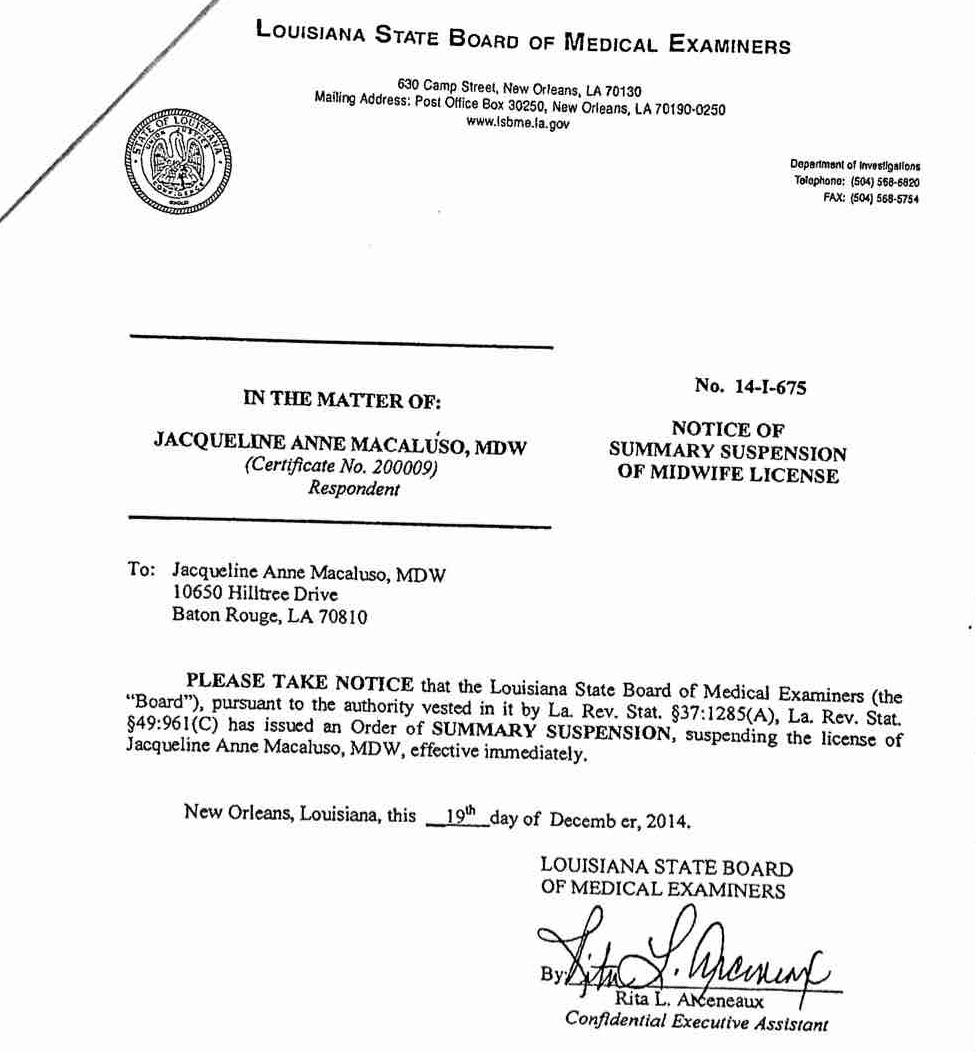
On or about December 19, 2014 my midwifery license in Louisiana was summarily suspended. It was alleged that I failed to disqualify a client for a home birth who was allegedly having a high risk pregnancy. No harm was done to the client or the newborn. The complaint was filed by a photographer attending the birth at the clients’ request. The parents have testified on my behalf that they would hire me again for the same birth experience. They wanted to hire me for their next pregnancy, but I was unable to accept clients since my license is still suspended.
The client, a 22 year old G3 P2 (pregnant with her third child, with two prior pregnancies and two living children), with no prior pregnancy or health complications. This client met the criteria of having a low-risk pregnancy as defined by the Louisiana Midwife Practitioners Act (MPA) Chapter 46:3241(12) of a:
“Low risk patient or an individual who is at low or normal risk of developing complications during pregnancy and childbirth as evidenced by the absence of any preexisting maternal disease arising during pregnancy or such other conditions as the board may identify in rules.”
The client entered my care on 2/20/2014. Before the client can enter my care, Louisiana midwifery regulations require an initial physician visit to assess the client and determine if she is a candidate for home birth. The client saw not only one physician for her initial medical evaluation, but two separate physicians at two separate times; both of whom indicated that this client was low-to-normal risk based on the absence of risk factors. This evaluation was in compliance with rule 5311(A):
“The licensed midwife practitioner must require that the client have a physical examination by a physician and be found to be essentially normal or at low risk before her care can be assumed. The initial physician examination shall include the physical assessment procedures which meet current standards of care set forth by the American College of Obstetricians and Gynecologists (ACOG).”
ACOG defines a high-risk pregnancy as one that threatens the health or life of the mother or her fetus. Risk factors associated with a high-risk pregnancy can include existing health conditions, obesity, multiple births, and young or old maternal age. Since these risk factors were absent the entire pregnancy, I concluded, in conjunction with my supervising physician, that my client was not experiencing a high risk pregnancy. This low-risk status was repeatedly indicated in the client’s medical records after thorough evaluation and examination by two different physicians at two different appointments in conjunction with my assessment, she was considered to be at a low risk for developing medical complications during her pregnancy; therefore midwifery care was initiated and continued in accordance with the definition in Chapter 53, subchapter A. Standards of Practice, rule 5301(A):
“Licensed midwife practitioners may provide care only to low risk clients determined by physician evaluation and examination to be prospectively normal for pregnancy and childbirth, and at low risk for the development of medical complications. Licensed midwife practitioners shall provide such care with supervision of a physician who is actively engaged in the practice of obstetrics.”
According to the MPA 46:3258(A) (Professional liability) the physician’s examination constitutes a risk assessment:
“Physician evaluation and examination as provided in R.S. 37:3244 shall be deemed to constitute a risk assessment. A physician performing a risk assessment is responsible only for determining that at the time of the risk assessment the individual is at low or normal risk of developing complications during pregnancy and childbirth. For any physician performing a physician risk assessment, the physician-patient relationship shall only exist for the purposes of the risk assessment and shall not continue after the conclusion of the physician risk assessment.”
Prior to initiating care, I provided the client with a copy of my risk assessment form to give to the supervising physician at the client’s initial visit for the purposes of establishing and informing the supervising physician of my legal parameters for safe and appropriate midwifery care. The risk assessment form is one I have created which I use to assess my clients throughout their pregnancy. This document is not a Louisiana legal requirement, rather a tool that I have devised to thoroughly and adequately assess my clients. Similar to the Florida risk assessment rules, had my client had a score of (3) or more, which she never did, my practice guidelines indicate that I would then make the appropriate consultation and/or referral. Louisiana rules do not delineate a low risk pregnancy from a high risk pregnancy. They only offer unapproved practice and occurrences when a referral or consultation are advised. Thus, Louisiana rules leave the final determination of risk status to the physician. I use this risk assessment form to discuss with the patient in determining their risk status and evaluating their risk score at the first visit. This client’s only risk score was 1 for previous baby over 4,000 grams and remained a risk score of 1 throughout the pregnancy, therefore it was determined by myself and my supervising physician to be a low-to-normal risk pregnancy and documenting that my care was competent and in compliance with rule 5309(A):
“All midwives will use risk factor assessments of their clients in order to establish their initial and continuing eligibility for midwifery services. Clients will be informed of their risk status. All midwives have the right and responsibility to refuse and discontinue services to clients based on these risk factors and to make appropriate referrals when indicated for the protection of the mother and baby. All final decisions on risk factors will be made by the midwife and the client’s backup physician.”
As evidenced in my chart, at my client’s initial visit with me, I reviewed the two sets of medical records from both physicians which assessed my client to be low-risk before my care had begun. The medical records contained the results of the medical evaluation, which did not identify any conditions which would preclude this client from midwifery care (in compliance of the rule 5353(A) (Initiation of Physical Care):
“General physical examination which included the taking of a comprehensive medical, obstetrical, and nutritional history sufficient to identify potentially dangerous conditions that might preclude midwife care.”
It is important to note that the client’s first physician, one that she had a relationship with for both of her previous pregnancies, dismissed her from his care after the initial visit on January 20, 2014. While an initial reason for dismissal was not given, the reason of “not trusting the client’s midwife’s skills” was given in a later email correspondence with the client even though the physician had no basis for this decision other than a personal bias formulated from the CPM and CNM he employs, as he has never witnessed my midwifery skills nor assessed them; he never returned the assessment forms given to him by the patient. Coincidentally, this physician invited the client to have her birth at his birth center instead of at home. His birth center, the only free-standing birth center in the state of Louisiana, opened in March of 2014, four months before the client’s EDD. This birth center happens to be located 5 miles from my home and well within my practice area. Also, the midwives who work at his birth center have demonstrated a personal bias against me as evidenced by written testimony from potential clients which disclose how the CPM at the birth center gave them distorted, inaccurate and untrue information regarding my practice and my past experiences. Again, not any physician in the state of Louisiana, nor any of the 12 practicing Louisiana licensed midwives have ever attended any appointments, labors or births nor assessed my skills; I’ve never even had to transport a client in the state of Louisiana. The same birth photographer, who was attending the birth of my client, happens to be employed at this physician’s birth center. The photographer testified to showing the midwives at the birth center the birth video without the client’s knowledge or permission; the midwives at the birth center encouraged the photographer to turn the birth video and all photos over to the Louisiana State Board of Medical Examiners. While the video was shared with my attorney in February, the original complaint filed by the photographer was not given to me until less than 24 hours before the hearing. Therefore, my case was further hindered by not being able to view the original complaint and not having the opportunity to depose the photographer or other witnesses like the CPM or physician from the birth center.
In addition to the five prenatal visits with two different obstetricians, this client had 12 prenatal appointments with me, all of which found the client to be low risk and in compliance of rule 5317(A). At every visit, her estimated weeks gestation was calculated, fundal height measured, fetal presentation determined by Leopold’s, fetal heart tones taken, fetal movement verified, assessment for any signs and symptoms of preterm labor recorded, cervical exam conducted (if requested or when appropriate), blood pressure measured, edema assessed, weight taken, urine dipped with the urinalysis reagent strips to provide tests for the following: glucose, bilirubin, ketone, specific gravity, blood, pH, protein, urobilinogen, nitrite and leukocytes. Urinalysis strips are useful in the preliminary screening for diabetes, liver diseases, hemolytic diseases, urogenital, and kidney disorders. Aside from a trace amount of protein seen on a urine dip at 18 weeks and 4 days at the supervising providers office, all of the vital signs and all of the tests on the strip for urine dips remained within normal limits and negative, respectively, for the entire course of pregnancy, both at prenatal visits with me and also with the supervising physician, further underscoring the conclusion that this client did not have kidney disease nor any other underlying, chronic, or acute illness, disease, or infection. Additionally, both myself and the physician had similar fundal heights within 1-2 cms of each other at each visit, indicating a corroborating measurement with was well within normal measurements for a baby of average/large constitutionally-sized newborn. Likewise, no edema was seen by either providers at any time. Besides normal routine antepartum care, the client had all of the required tests seen in rule 5355(A) and 5313:
“The midwife shall conduct or arrange for additional laboratory tests as indicated, including Rh antibody screening, blood sugar screening, gonorrhea culture, and periodic hematocrit or hemoglobin screening.” “Clinical pelvimetry… GC screen, blood group and Rh, hematocrit or hemoglobin, rubella titer, and urinalysis. Additionally…a VDLR test.”
Per Louisiana rules, the glucose screening is not required. Additionally, it is of importance to note that a urinalysis was required and performed at the initial examination by the first physician. The urinalysis was determined to be normal and not requiring any follow-up care. My client was under the care of this first physician, whom she notified via a phone call of her visit around 12 weeks gestation to an urgent care clinic to see an emergency-care physician regarding a “kidney infection” as reported by the client. At the urgent care clinic, the client was given antibiotics and a steroid injection after which she called her first physician to inform him of her infection and inquire if the antibiotics were safe for use in her pregnancy. The first physician confirmed that her antibiotics were safe and to set an appointment for an initial visit in about a month at which time her infection cleared as evidenced by the lack of signs and symptoms and a test of cure. At my initial visit with the client, she informed me of her prior “kidney infection.” The client’s history was free of urinary tract infections and related kidney disorders and disease. Additionally, if the client had the alleged “kidney disease,” she would have presented in her pregnancy with signs and symptoms of kidney disease and would have been evidenced by protein in urine, edema, urinary tract infections, hypertension, low blood cell count, appetite loss, general ill feeling and fatigue, headaches, itching and dry skin, nausea, weight loss without trying to lose weight—none of which this client presented with at any time during her pregnancy and usually associated with chronic kidney disease in pregnancy (Williams and Davison, 2008). This client did not experience preterm labor or low birth weight further indicating a healthy, low-risk pregnancy. Therefore, I concluded based on medical records from the two initial visits with the two different physicians at two different times that indeed the infection had been of short duration, responded well to antibiotic treatment and had completely resolved, returning her to low risk status. Given that antibiotics were administered in an out-of-hospital setting, a follow-up negative test of cure a month later, no signs and symptoms of chronic disease, and no present signs or symptoms of infection, I concluded that the transient infection had cleared and was no longer present. Thus, it was determined that this client did not have kidney disease or any kidney dysfunction outside normal pregnancy parameters. According to the American Association of Family Physicians, posttreatment urinalysis and urine culture are unnecessary in patients who are asymptomatic after therapy. Also, the British National Formulary offers the following information: “After finishing the antibiotic therapy indicated by the prescriber, the pharmacist should give a follow-up appointment to the pregnant woman. A dipstick urine test is encouraged after treatment of the primary infection to ensure response and then monthly for the remainder of the pregnancy to monitor for recurrence” (2011).
Informed consent was implemented throughout various stages of the pregnancy and signatures were collected on appropriate informed consent documents after thorough discussions with the clients occurred and adequate time to discuss risks, benefits, alternatives, as well as answer any questions pertaining to tests, and screenings regarding standard midwifery care offerings was conducted. This was in compliance with rule 5315(A1) (Acceptance of Clients):
“Prior to the acceptance of a client for care, a licensed midwife practitioner shall inform the client orally and in writing that: Certain risks and benefits exist for home birth and certain risks and benefits exist for other childbirth alternatives (including hospital, physician-assisted birth). The midwife is responsible for informing the client of the risks and benefits of all childbirth options to ensure informed consent.”
The Louisiana State Board of Medical Examiners (LSBME) is authorized to “promulgate and publish rules and regulations for the purpose of administering the provisions of [The Midwifery Practitioners Act (MPA)],” not to constrict the practice of midwifery, which the LSBME unlawfully does when it refers to “back-up physician” in rule 5315 (A4):
“The client must make arrangements for the services of a backup physician located within a 50 mile radius of the client’s home and the planned delivery site.”
A practice rule cannot be enforced if no authority for the rule is given in the practice act. The LSBME demonstrated its understanding of this violation by conveniently wording that “the midwifery rules contemplate” a back-up physician, because it is unlawful to require one according to the MPA. A back-up physician is neither defined nor mentioned in the MPA. The MPA requires the midwife to produce “a description of the protocol for transfer to a hospital.” Similar to Florida law, the MPA states that:
“No physician or other healthcare provider as defined in RS 40:1299.41, no hospital as defined in RS 40.2102, or no institution, facility, or clinic licensed by the department shall be: deemed to have established a legal relationship with a licensed midwife solely by providing a risk assessment as defined in this section or accepting a transfer of a patient from a licensed midwife.”
I satisfy all of the required information through the use of an “Emergency Back-up Form” identical to one used in Florida. I complete this form, using the patient’s preferred physician, group, hospital, and other parameters like distance to nearest hospital with emergency services, distance to nearest hospital with obstetrical services, distance to nearest hospital with nearest NICU. This form is completed prenatally. This client did make arrangements within 50 miles of her home and the planned delivery site for the services of a backup physician. The requirements imposed by 5315 (A4 and A5) were satisfied:
“The midwife will develop and implement a plan for obtaining consultation from and/or referral to the client’s backup physician, and will consult with the client’s backup physician or transfer the client when necessary.”
The client made an informed decision to decline the glucose screening as she desired minimal screenings as part of her care; however, per my protocols, she was carefully monitored throughout pregnancy for signs or symptoms (blurred vision; fatigue; frequent infections including those of the bladder, vagina, and skin; increased thirst; increased urination; nausea and vomiting; weight loss despite increased appetite) associated with diabetes and through urine dips, diet and exercise counseling; no signs and symptoms of diabetes was seen in this pregnancy. The American Dietary Association and ACOG guidelines state that a low-risk pregnancy requires no glucose testing for those women meeting all of the following criteria: age <25 years; weight normal before pregnancy; member of an ethnic group with a low prevalence of diabetes; no known diabetes in first-degree relatives; no history of abnormal glucose tolerance; no history of poor obstetric outcome. This client met all these criteria; she was 22 years old, 5 feet tall, 115 pounds (prepregnant weight) or 18 BMI, 160 pounds delivery weight, not a member of an ethnic group with a prevalence of diabetes, no known first-degree family members with diabetes, no history of abnormal glucose, and no poor obstetric outcome. Therefore, I could safely discuss her lower risk status for having gestational diabetes, even with a history of a large baby, even though I counseled and encouraged the glucose screening. The mother documents her knowledge and understanding of her risk in having a homebirth with a history of large babies as evidenced by her birth plan which states:
“Make yourself comfortable, you are more than welcome to chill on the couch, play with my kids, read a book, help yourselves to something in the kitchen. We are having a hypnobirth. Please nobody talk to me during labor (with the exception of my husband), if you need something, you are more than welcome to ask my husband. If I retreat to my kid’s room this means I want to be alone. I’m fine with people observing me in there, but I don’t want to know you are in the room. In other words, don’t touch me, stand off to the corner, and shhh… I do not want my baby to have formula for any reason, I would like my baby to receive all of its blood from the placenta, so I want the cord to finish pulsing.” Anything that has to be done to the baby can be done with the cord still attached. If we end up going to the hospital, someone please save the placenta for me. Do not let them put triple dye or eye ointment on my baby. I do not want my baby to receive vitamin K or Hep B. No routine tests unless there is a suspected problem (not baby is big so let’s check blood sugar.) I’ve been known to have big babies, unless there are symptoms of an issue I’m fine assuming all is fine with the baby’s blood sugar…I’d like for this to be as least traumatic for myself and my baby, so if something isn’t completely necessary then I really would like to avoid it.”
Frye notes that Macrosomia can be applied to all large babies, but is a rather vague term. Large-for-gestational age (LGA) babies tend to be clumped into a pathological category denying the fact that healthy, bigger-than-average babies are often born to well-nourished women. Indeed this client was counseled to have a healthy diet and she was following the Brewer’s diet, one that notoriously creates larger, healthy babies. Because this baby, as seen on the 36 week ultrasound had all measurements in proportion, or symmetrical, one can concur that the baby was constitutionally destined to be large as the hereditary pattern may suggest. Well-nourished women also may carry slightly past their due date, which is what happened in this client’s pregnancy. This leads to babies who are born healthy in every way but may be larger than average. Additionally, a significant number of hospital births now take place after induction and as scheduled repeat cesareans, many of which are done at 38-39 weeks of pregnancy, resulting in lower birth weight babies and increased risks of prematurity-related problems. Statistically, these interventions “lower the bar” for what is considered a large baby.
The Cochrane Review found:
“The best way of identifying and treating women with abnormal blood glucose tests in pregnancy is not known. Raised blood glucose levels during pregnancy is known as gestational diabetes. This abnormality may be associated with bigger babies, more difficult births and could be associated with higher rates of operative delivery such as caesarean section. The review of eight studies (1418 women) suggests that offering specific treatment for gestational diabetes may be associated with better baby and mother outcomes, but has not found robust evidence on the best choice of treatment which provides the better outcomes for these women and their babies, even if identified correctly. More research is needed to assess long-term mother and baby outcomes. Women are often intensively managed with increased obstetric monitoring, dietary regulation, and insulin. However, there has been no sound evidence base to support intensive treatment. The two main approaches to screening are ‘universal’ where all women undergo a screening test for gestational diabetes screening; and ‘selective’ where only those women at ‘high risk’ are screened. It is however unclear whether screening for gestational diabetes screening leads to better health outcomes and if so, which screening strategy is the most appropriate. Therefore, it was concluded that there remains insufficient evidence to determine if screening for gestational diabetes, or what types of screening, can improve maternal and infant health outcomes.”
Henci Goer’s research states:
“Santini and Ales report results from a national trial that occurred in the early 1980’s when some doctors at Cornell University Medical Center screened women for gestational diabetes (GD) routinely and others did not. No differences in perinatal mortality, morbidity, LGA or macrosomia rates were found between screened and unscreened populations, but women in the screened population were more likely to have primary cesarean sections (19 percent versus 12 percent), more clinic visits, more fetal surveillance tests, and more prenatal hospitalization (Santini et al. 1990). As Santini and Ales’ study suggests, not only does GD management offer little benefit, it confers risks, the gravest being a marked increase in cesarean section. Many doctors view high cesarean rates as a reasonable trade-off for preventing shoulder dystocia. This ignores that many shoulder dystocias occur in non-macrosomic infants (Keller 1991) and that the increase in cesarean rate for infants weighing over 4000 g has not improved outcomes (Boyd et al. 1983); not to mention the role typical obstetric management plays in causing shoulder dystocia. Increased likelihood of cesarean is not the only risk of GD management. Finally, the poor predictability of the fetal weight estimates and surveillance tests doctors feel obliged to order, even the belief that GD is a high-risk condition, undoubtedly lead to countless unnecessary inductions and operative deliveries. Researchers take note that sonography to estimate fetal weight did no better than a coin toss at predicting macrosomia and recommended it anyway (Combs et al. 1993).”
Because gestational diabetes affects only a small amount (approximately 3-6%) of all pregnant women it is important to recognize that some clients will exercise their right to refuse the screening. Even ACOG recognizes a woman’s right to decline the screen:
“These [gestational diabetes] guidelines should not be construed as dictating an exclusive course of treatment or procedure. Variations in practice may be warranted based on the needs of the individual patient, resources, and limitations unique to the institution or type of practice. (ACOG, 2001) Pregnant women’s autonomous decisions should be respected. Concerns about the impact of maternal decisions on fetal well-being should be discussed in the context of medical evidence and understood within the context of each woman’s broad social network, cultural beliefs, and values. In the absence of extraordinary circumstances, circumstances that, in fact, the Committee on Ethics cannot currently imagine, judicial authority should not be used to implement treatment regimens aimed at protecting the fetus, for such actions violate the pregnant woman’s autonomy. (ACOG, 2005)”
Per Louisiana standards, this client was eligible for a home birth as determined multiple times by the first physician, the supervising physician and my assessment. Sound judgement was used in determining the client’s qualification for an at-home birth, again, as evidenced through the absence of risk factors on the assessment form and by the supervising physician’s continued assessment that the client was low-to-normal risk for an at-home delivery. The state’s expert witness testified that the supervising physician’s initial assessment was based on misinformation supplied by the patient, even though in my medical records requested from the physician are complete for a patient history. Therefore, it can be concluded that the state may have removed pages from the supervising physician’s medical documents to make it appear as though information was being withheld. This unethical, unlawful maneuvering was found at every step of this investigative process to my detriment.
At no time during the pregnancy, did certain medical conditions and/or noncompliance with my requirements or physician recommendations preclude my attendance at the birth or continued midwife care during any phase of the pregnancy, in accordance with rule 5315(A3). Likewise, under my care, the requirements for the supervision of a physician exceeded that which is required by rules in the definition set forth by 23:2303:
“The client shall be seen by a physician for the physical examination at least once during the first or second trimester of pregnancy and again at least once within the last four weeks of pregnancy.”
In compliance with rule 5319(A)(Physician Visit), my client was evaluated and assessed at 35 weeks and 5 days, by the supervising physician to be low risk and have no medical contraindications for delivery by a licensed midwife or for a home birth:
“Each client must be evaluated by the supervising physician at or near the thirty-sixth week. The purpose of this visit is to ensure that the client has no potentially serious medical conditions and has no medical contraindications for delivery by a licensed midwife practitioner or for home birth.”
This initial physician examination and evaluation included clinical pelvimetry, which is important to note because I used this satisfactory evaluation in confirming my pelvic assessments conducted at the client’s 39 week prenatal visit where I conducted a pelvic exam. In conjunction with this client’s history of a proven pelvis and normal, spontaneous, vaginal birth of a 10 lb 14 oz baby at home without the attendance of a healthcare provider and these separate, but conferring clinical findings of an adequate pelvis lend towards my decision to continue to care for this client even with the ultrasound report showing fetal weight in the 95th percentile. The client understood she was at a higher risk for having a larger baby since her husband’s family history includes 12 pound babies delivered vaginally from normal, healthy women. The client’s first baby was with a different father and was delivered in a normal, spontaneous, vaginal delivery at 38 weeks gestation weighing 7 lbs 6 oz.
My assessments, including a clinical pelvic assessment and a normal fundal height measurement (within 1-2 cms of estimated weeks), concurred with those of the collaborating physician, that this client’s pregnancy was progressing normally and she could be expected to have a normal, healthy, low risk labor and birth. I utilized appropriate risk factor assessments, counseling, preparation for childbirth, and appropriate supervision throughout the pregnancy in assessing the client’s health status as normal and low risk. The scope of practice as defined by the MPA 46:3244(B) states that:
“The licensed midwife may provide care to low risk patients determined by physician evaluation and examination to be essentially normal for pregnancy and childbirth. Such care includes prenatal supervision and counseling; preparation for childbirth; and supervision and care during labor and delivery and care of the mother and the newborn in the immediate postpartum period if progress meets criteria generally accepted as normal as defined by the board.”
Under my care, on 7/21/2014 this client’s labor began. The client had an appointment scheduled later on that Monday with the supervising physician as she was approximately 41 weeks 1 day. However, because the client had a miscarriage the month before this pregnancy’s conception and is tandem nursing her 2 and 4-year olds, it was not entirely clear when she ovulated nor when she conceived; hence an uncertain estimated due date. Additionally, her first ultrasound was at 23 weeks, which is not accurate for a “dating” scan. Therefore, these due dates are approximate.
I arrived at the client’s home around 5am. I introduced myself to the photographer but did not say any of the things she attributed to me saying. For example, if I truly was uncomfortable with a photographer at the birth, I would have asked her to leave. Later in the labor, the photographer asked how many centimeters the client was at that time. Per HIPAA, I do not disclose medical information, rather deferring the photographer to ask the client, if she needed to know such details. The photographer, who again, had no medical training and has only attended one other homebirth, stated in her initial complaint that I “was not using any maneuver that [she’s] seen used in similar situations.” Besides the reason that this was not a shoulder dystocia, the photographer did not see any of the same maneuvers as she has seen in the hospital because she was at a home birth and our standard of care is based on ambulatory clients. The father testified that the baby did not fall out and onto the floor, as the photographer alleged. Again, without medical training, it is difficult to ascertain what a limp, from partially flexed newborn looks like, which was clearly the case as to why the photographer said the baby was “completely limp.” As the baby was born, her tone was not one of a baby with no tone; she had some flexion, and after about 90 seconds her flexion reflected that of a healthy, normal newborn. The photographer claimed that she never saw me suctioning the baby, which is not true. The father testified to seeing me suction the baby, take fetal heart tones, and vitals on both the mother and baby. However, because she was behind a camera lens, standing about 5 feet away, in a doorway, behind three other people, she may have missed all that I was doing. Plus, when I decided to activate 911, I asked her to make that call and she left the room entirely; therefore she could not claim to have seen or not seen me do a certain procedure when she was not in the room the whole time. The baby’s and mother’s vitals were being monitored at all times. Again, without medical experience, it is hard to know when or how vitals are being taken. For example, the base of the umbilical cord was being palpated for the baby’s heart rate, if the Doppler was not being used. The cord was clamped and cut about 20 minutes postpartum, well after the baby had successfully transitioned to extrauterine life, the cord had ceased pulsing, it was white and flaccid, and the placenta had detached. The cord bands I use to clamp the cord require the cord to be cut before I can clamp them. Some residual blood that was in the cord leaked out after cutting, but was quickly soaked up in a 2×2 gauze pad after clamping was finished. The photographer was mad that I did not wait for her to be poised for photo before cutting the cord, so we “redid” the cord cutting later with the father cutting the cord. I was never rude or demanding to any of the assistants at the birth.
The photographer and doula offered to help me at multiple times during the labor and actually you can see the photographer gladly handing me the mirror in the video. About 25 minutes postpartum, the mom did feel weak as she was getting out of the tub, so to avoid a vagal response, I laid her down on a spot beside the tub. It is common standard of practice to have a place beside the tub for mothers to rest, if making it to the bed may be unwise. Again, it is understandable to the layperson to not understand what a placenta looks like, but seeing that the photographer was on the other side of the room taking photos of the baby and father, it is not unfathomable that she could not have heard me say that the placenta was delivered intact or she could have heard the doula state that she just needed a piece for encapsulation per the client’s wishes. I am really not sure why the photographer was even concerned with the placenta. She did not take any photos of it. With the delivery of the placenta, the client lost about 500 cc of blood, which is considered a sign of pending post-partum hemorrhage (PPH). This potential PPH resolved with usual management and delivery of the placenta. I did auscultate the baby several times after birth and after the newborn exam because I was hearing some “junky” sounds, transient and not unusual in the first few minutes of life, which is probably what the photographer overheard me explaining to the parents, but as mentioned before, I do not converse about vital signs with photographers or any laypersons at births, so misunderstanding could occur since she was hearing this second-hand. Before leaving the birth, while I was finishing charting, I asked the photographer if she had any questions about the birth and explained that if she needed to process the birth, I would be happy to discuss it with her at any time postpartum. She did not seem uncomfortable at any time with the birth or postpartum period and stated she had no questions. The photographer did not leave as soon as possible after birth, she stayed almost 3 hours postpartum.
A local, Louisiana licensed midwife, watched the birth video and agreed that she would have not done anything differently during the labor or birth. She stated that my actions were within the standard of care for midwives in Louisiana. Per the client’s written birth plan, she desired a private, noninterventive birth alone with her husband:
“Make yourself comfortable, you are more than welcome to chill on the couch, play with my kids, read a book, help yourselves to something in the kitchen. We are having a hypnobirth. Please nobody talk to me during labor (with the exception of my husband), if you need something, you are more than welcome to ask my husband. If I retreat to my kid’s room this means I want to be alone. I’m fine with people observing me in there, but I don’t want to know you are in the room. In other words, don’t touch me, stand off to the corner, and shhh…”
The photographer spent much of the labor in her car or on the couch in the living room away from the laboring mother who spent most of her time in her kids’ bedroom. The photographer even left the client’s house and went home for several hours during the labor. Because I was not in the room the entire time with the client, per her wishes, I observed as unobtrusively as possible and took vital signs as required to make sure mother and baby were doing well, the photographer misconstrued this lack of continual presence as lack of care. This could not be further from the truth. During labor, as evidenced by my chart and also as explained at the hearing by the client’s husband who was nearby the client for nearly the entire labor, his testimony included seeing me taking fetal heart tones with my Doppler and taking vital signs (pulse, blood pressure, and temperature). Furthermore, Louisiana midwifery regulations do not indicate how fetal heart tones are to be assessed. I used my Doppler, palpation, and observational skills to assess FHT, demonstrating that I was in compliance with rule 5355(B):
“Fetal heart rate and rhythm shall be made at least every 30 minutes during first stage, after each contraction in second stage and after rupture of membranes. The duration, interval, and intensity of uterine contraction and material blood pressure shall be recorded at least every hour and immediately after delivery.”
With descent especially during crowning, fetal heart sounds are more difficult to follow with an anterior placenta and posterior baby. Therefore, it is advantageous to use other methods of determining fetal well-being; one of the most tangible and easily monitored indications of fetal well-being is the fetal movement that occurs between contractions. The mother felt this movement after the head was born in between contractions. The mother did not indicate any fetal movement during the contractions, nor did I feel or visually see any fetal movement during contractions, suggestive of normal, healthy fetal behavior. According to research, abnormal patterns in the second stage are only significant if there were abnormal patterns in the first stage of labor (Sheiner et al. 2001; Loghis et al. 1997; Wu, Chen & Wang 1996). There were no abnormal patterns in first or second stages; therefore I could remain assured that the FHT would remain normal in the second stage and delivery. I attended to the condition of the baby by auscultating the fetal heart rate with a Doppler equipped with a display so that unnecessary sound was not heard (per the mother’s birth plan), evaluating the scalp color, checking perfusion of the scalp, and assessing the fetal heart rate by watching the anterior fontanelle. The color of the scalp is a good gauge of fetal well-being and oxygenation. This is noted as pink to pink-lavender. Blanching the caput on the scalp with color returning in no more than three seconds is suggestive of good perfusion. An increasingly dark color in a vertex presentation almost always indicates venous congestion in the baby’s head from impaired blood return, which was not evident at any time in this delivery. The father of the baby, who was with the client for nearly the whole labor and delivery, testified to witnessing my fetal heart tones assessment many times during labor. Therefore, despite the lack of video evidence of a clinical fetal heart tone measurement with a Doppler, fetal heart tones were being assessed via “special observational skills required for out-of-hospital deliveries” as recognized as stated in Rule 5303(A) (Skills), after the birth of the fetal head.
Crowning of the fetal head was normal-to-fast for an occipital posterior (OP) baby, which is correlated to a longer, more painful labor and birth. If crowning had taken longer, I would have noted this and prepared for a complication like shoulder dystocia, but since the mother had a normal (about an hour) second stage and crowning was just as efficient (within 2 contractions) I could safely conclude that the birth was at a low risk for a shoulder dystocia. Plus, this client and her husband stated that their previous baby (10 lb 14 oz unassisted birth) had been born the same direction (OP), with the same physiological pause in the delivery, reconfirming once again that this client’s proven pelvis could birth this OP baby.
Total time in labor was 10 hours and 17 minutes, very normal for a third baby. Second stage was just over one hour, well within the normal amount of time for a labor that was progressing normally, not protracted in any way, physiologically unfolding as necessary with a normal, adequate descent of the fetus, indicating a low risk for shoulder dystocia. This baby had been in an occipital posterior (OP) position for most of the client’s pregnancy probably associated with the anteriorly-placed placenta. An OP position is not wrong or a problem, it is a head-down position. It is not caused by anything the woman does or does not do. Instead, it is a variation that occurs when a baby gets into the ‘optimal position’ for his journey through his mother’s unique body. Only 5% of babies will be born in the OP position, which is important to note, as many providers will have very limited experience with seeing an OP baby; therefore they will not be able to accurately assess the situation or will incorrectly compare the OP presentation to an occipital anterior (OA) position which occurs in 95% of births. Because of the sacrum and pelvic floor, the OP baby usually does not have the room to maintain as much flexion as the OA fetus. This client’s fetal head was well-flexed and maintained it upon birth, further indicating adequate room in the maternal pelvis. I assisted with maintaining flexion by supporting the maternal tissues nearest the fetal forehead. After the head was born, perfusion was maintained, the baby was not trying to breathe (the baby was well oxygenated through the placenta), the water in the tub was clear, no turtling sign was ever seen, no meconium or blood was evident, indicating no shoulder dystocia or other complication. Using my hand, I ran my fingers around the fetal neck to check for a nuchal cord, which was not evident, and position of shoulders, which was transverse. I felt the top of the shoulders perpendicular with the long axis of the head, a reliable indicator of the location of the long axis of the shoulders (Frye, 2004). The neck did not seem unduly stretched or twisted in any way, further confirming that this was not a shoulder dystocia.
At this time, the head was snug (not turtling) against the maternal tissues, and the fat face was pink-to lavender. With the next contraction the head should externally rotate, signaling that the shoulders have made their rotation preparing for birth and the neck will appear. According to Frye, it is very important to give the baby a chance to spontaneously rotate shoulders. Usually shoulders are born in the next contraction, but if they are not, it is fine to have hands poised but off the baby until the next contraction. Not providing support allows the weight of the head to assist internal rotation and birth of the posterior shoulder, especially when the mother is upright. Many providers manipulate the head without regard to timing contractions, allowing little patience in waiting for the uterus to assist in rotation of the shoulders or further descent of the newborn. Sutton and Scott explain that an upright maternal position in conjunction with the shoulders being born spontaneously, the need for episiotomy and the rate of shoulder dystocia is rare, almost nonexistent (1996). After the head is fully born, it is common practice to wait for the next contraction for the shoulders to rotate. Kotaska and Campbell’s research found that “a belief that prolonged head-to-body delivery interval endangers the newborn underpins the common obstetrical practice of delivering the baby’s trunk immediately after the head is born. Without intervention, however, birth typically occurs in two steps: once the fetal head is delivered there is usually a pause, and the rest of the infant is born with the next contraction. Allowing a two-step delivery does not increase the risk of fetal harm, and may lower the incidence of shoulder dystocia. A two-step approach to delivery should be considered physiologically normal. This has implications for the definition of shoulder dystocia” (2014).
Snug shoulders are often given the misnomer “mild” shoulder dystocia and most likely do not meet the definition of the impingement (or impaction) of the anterior shoulder or both shoulders above the pelvic brim. Snug shoulders can occur with a large baby, an adequately shaped pelvis, and a somewhat obese mother, which together comprise a soft tissue dystocia. The head is born very slowly but the midwife does not need to push the perineum back manually in order for the head to be born. The baby’s face is fat but the baby does not really exhibit the turtle sign as the head goes through both restitution and external rotation. The shoulders are tight and take more effort to deliver, but making sure the shoulders are in the oblique diameter of the pelvis, a little suprapubic pressure, and an exaggerated lithotomy position readily take care of the problem, as does having the mother get into the hands-knees position (Varney, p. 884). The incidence of shoulder dystocia is generally reported as less than 1 percent. According to Varney’s Midwifery, shoulder dystocia may occur from 0.2 to 2 percent of vaginal cephalic deliveries, yet an accurate figure probably does not exist due to problems with accurately establishing the incidence of shoulder dystocia. The textbook also notes that defining shoulder dystocia is critical to determining what steps to take to resolve it. The basic and anatomically correct definition of shoulder dystocia refers to cephalic presentations in which the anterior shoulder is wedged above the symphysis pubis instead of entering the true pelvis; however, in the clinical setting, the diagnosis is subjective and based retrospectively on observation (Varney, p. 883).
The Unnecessarian states that the following quote is from page 140 of Munro-Kerr’s Operative Obstetrics (2007) by Baskett, et. al.:
“Unfortunately, attempts to find factors that will accurately predict shoulder dystocia and allow a practical prevention strategy have been unsuccessful. Most of the antepartum risk factors have fetal macrosomia as the underlying theme. Many of these risk factors are common, while the condition they predict, shoulder dystocia, is not. Furthermore, the risk of serious fetal injury associated with shoulder dystocia is rare. The hope that ultrasound prediction of fetal weight and more detailed ultrasound measurements such as shoulder width would provide an accurate level of risk have been unfilled. Indeed, for the macrosomic fetus, clinical estimation of fetal weight is as accurate as that predicted by ultrasound. Even if one could predict fetal macrosomia accurately, it would be of limited value. About 95% of infants weighing over 4000 grams will not have shoulder dystocia. It has been suggested that elective caesarean for fetuses weighing more than 4500 grams would reduce shoulder dystocia and fetal injury. A decision analysis model has shown that this strategy would be both clinically and cost ineffective; it was estimated that to prevent one permanent brachial plexus injury 3695 caesarean sections would be required. Furthermore, the majority of cases of shoulder dystocia occur at fetal weight less than 4500 grams. Thus, both the antepartum and intrapartum risk factors lack sensitivity and specificity. Having said that, there are individual cases with cumulative risk factors such as maternal diabetes and estimated fetal weight > 4250 grams which may be best delivered by caesarean section. A combination of factors such as clinical fetal macrosomia with a protracted late first stage of labor and slow descent in the second stage requiring assisted mid-pelvic delivery may dictate that caesarean delivery would be more prudent.”
Because shoulder dystocia involves both the size of the baby and the size and shape of the mother’s pelvis, it is important that the clinician determine that the mother’s pelvis is adequate to deliver a healthy baby. In addition to performing pelvimetry during pregnancy to determine that the mother’s pelvic architecture would accommodate a good sized baby, I knew that this client’s pelvis had been proven adequate for a large size baby in her previous delivery.
However, having not known the baby’s true weight, it is impossible for me or any other provider to have an exact assessment using fetal weight in managing this delivery. It is not illegal nor against regulations to attend or deliver a macrosomic baby at a home birth. Furthermore, the allegation that this mother had a true shoulder dystocia for her second birth is unfounded. The mother has no medical background and reported “an approximate two-minute shoulder dystocia” with the birth of her second child that resolved after she stood up. However, both physicians noted in their medical charts that this client had a “NSVD” for the birth of this baby because, according to most definitions of shoulder dystocia, it cannot be resolved without maneuvers and assistance, none of which this mother could perform on herself during delivery. Therefore, I concluded that while the mother may have perceived her second birth as a shoulder dystocia, it was another anomaly due to the OP position of that baby. Coupled with no other injury or complications, there was no justification for induction or cesarean.
The Unnecessarian also refers to the obstetrics textbook, Munro Kerr’s Operative Obstetrics (2007) by Baskett, et. al., which states the following on pages 139-40:
The rate of repeat shoulder dystocia in a subsequent vaginal delivery has been reviewed in six series and the risk of recurrence ranges from 1.1% to 16.7%. The average recurrence rate was relatively low at 10.1%. However, in a case with previous shoulder dystocia and brachial plexus injury or other complication, caesarean section could be justified in the next pregnancy. Six studies were reviewed with a combined total of 2054 subjects. Data was collected between 1980 and 1999.
SD (shoulder dystocia) is an unpredictable high-stress medical situation for which there is no uniformly helpful protocol. In addition, some doctors define SD’s occurrence when basic maneuvers are required; others call it SD when more difficult measures are required. All doctors frequently encounter these situations so strict definitions are somewhat arbitrary. Most doctors have encountered many a case of significant shoulder dystocia where there are absolutely no risk factors. There are various guidelines for handling such deliveries well-known to the practicing doctors including ACOG educational bulletins on the subject. Despite studies dating back over thirty years that attempted to define reliable predictors of SD, there are no management protocols that, if followed, will consistently prevent SD-related brachial plexus injury. For example, the most recent ACOG practice bulletin states, “shoulder dystocia is most often unpredictable and unpreventable…. In each case, risk factors can be identified, but their predictive value is not high enough to be useful in a clinical setting.”
After the head emerged, I looked at my wristwatch and announced the time. It was almost exactly two minutes later when the mother had her next contraction, not an uncommonly long wait for a normal physiological delay and not a diagnosis for shoulder dystocia. As we waited for the next contraction, the mother could feel the baby rotating and gathered her strength to push the baby out. We discussed changing positions, but the mother was comfortable in a semi-sitting position in the birth tub as she desired a water birth. However, after the next contraction and the weak pushing efforts of the mother, the fetal head did not move indicating that assistance was needed. I immediately assisted the mother into a squatting position, where I continued to assess the position of the fetus and encourage the mother to push, but she was no longer having a contraction. I could feel that after the mother got into the squat position, her baby’s head was wiggling as restitution occurred. Likewise I could feel that the shoulders had rotated to an oblique position and descended further into the introitus. “However, not every persistently posterior labor follows this pattern, and the etiology of persistent posterior positioning and rotation remains not fully understood” (Frye, 2004). I asked the mother to get out of the tub and she stood up and continued to attempt to push. The shoulders should normally emerge spontaneously, but with the OP position of the baby, the mother’s weak pushing efforts, and tight perineal muscles I needed to check again for a tight cord or a nuchal hand that could be hindering emergence. Often mistaken for shoulder dystocia are snug shoulders. Sometimes the descent of a big baby will be delayed as it squeezes through the healthy, well-padded soft tissue of the birth canal. This can, at first, appear to be a bigger problem when it occurs before the shoulder emerges, namely bone-on-bone dystocia. The suction must be broken to advance the baby (Frye, 2004). Additionally, I also palpated the mother’s abdomen above the pubic bone to determine if I could feel a shoulder lodged behind the pubic bone, which I could not feel, because it was not a shoulder dystocia. As the client stood in the tub, it was determined by palpation that neither a tight cord around the neck nor a compound presentation was evident, therefore I decided that more guidance was necessary to effect birth, but that this needed to be accomplished outside the birth tub.
Again, I asked the mother to remove herself from the tub and I assisted her safely out into a standing position facing the tub. By both sight and touch I could determine that the shoulders were snuggly waiting just inside the introitus. The mother was upright and did not reach to assist the birth herself, therefore I reached around the back of the mother and with my left hand I formed a collar for the baby’s neck by holding the fingers of my left hand in the shape of a “C” and poised that palm at the back of the baby’s neck. I was prepared to apply my palm to the upper back and support the shoulders with my fingers as they emerged, directing support against the back and shoulders, rather than to the side of the neck. No excess force or traction was applied to the head; at no point did I shake the fetal head from side to side as it was alleged.
A woman’s body is physiologically incapable of opening and allowing a baby through unless she gives in to the process, releases and lets go. Unfortunately, anytime the laboring women tenses or tightens in response to fear, pain, or anxiety, the uterine muscles also tighten, making the contractions less effective, inducing more pain, and slowing down the entire process. The state’s expert witness (a non-practicing obstetrician) stated that after watching this birth, she concluded that it was “traumatic” even though she was not even present for the birth. Hearing a woman vocalizing as a natural coping mechanism for labor can be unsettling to practitioners whose patients typically labor with epidurals. Midwives who attend unmedicated births in homes and birth centers are used to the noises women make in advanced labor. Because physicians, like the expert witness, have never seen a home birth, a water birth, or an OP birth without medications, it is easy to assume that the experience would be traumatic, if screaming was ensuing. However, as stated earlier, OP babies are notoriously more painful than an OA delivery, and this baby’s size was bigger than most, making it more challenging than a typical birth. The mother and father did not think the birth was traumatic in the slightest bit. With the combination of the large part of the fetal head causing a great stretching and tension on the perineum, and a mother, who was visibly tense and unable to mentally assist in her pushing efforts, I used an indigenous technique utilized by midwives all over the world to assist in the birth called “shaking the apple tree” (Gaskin, 2012). This is also known in birth ritual circles and belly dancers as shimmying and has been used for centuries in helping babies descend in labor. I applied this technique by placing my hands on the backs of the client’s thighs just under the buttocks and vibrated in a gentle, rhythmic fashion until the fetal body emerged. This technique releases the maternal tissues helping to relax the pelvic floor, the buttocks, and the thigh muscles to encourage spontaneous delivery. Feeling that the perineum was taut and knowing that there is no consistent evidence that an episiotomy is needed in this scenario (although it can help in certain situations), I chose not to perform an episiotomy as it was felt that the patient’s body habitus would negate the effectiveness of an episiotomy and more time would have been spent moving the mother into position to perform this procedure because I was being cognizant of the time that elapsed, so that the continuation of appropriate and coordinated maneuvers could be ensured. The head-to-body delivery time was about 4 minutes and 20 seconds (well within a safe timeframe for a baby to be born), based on the time I looked at my watch after the head was born until the sound of the amniotic fluid splashing on the floor after the baby was born.
Similarly, in a study of over 8000 births, Stallings et al. observed no correlation between head-to-body delivery interval and cord pH in 134 cases of shoulder dystocia. Among cases lasting three minutes or more, the mean pH was 7.26; the pH remained normal when two or more maneuvers were required and when neonatal brachial plexus injury occurred. “The implication of these findings is that a ‘rush’ or ‘crash’ delivery of the fetus with shoulder dystocia is unnecessary.” Once delivered, the fetal head is exposed to atmospheric pressure. While the uterus is flaccid and the mother is not pushing, intrauterine pressure is 10 to 15mmHg above atmospheric, allowing venous return from the fetal head to the fetal thorax. With a contraction, intrauterine pressure rises to 60 to 80mmHg and with maternal effort, to more than 100 mmHg above atmospheric. At this pressure, venous blood cannot return from the fetal head to thorax, and cerebral perfusion ceases. Local brain hypoxia and metabolic acidemia can occur rapidly, even though circulation and oxygenation of the rest of the body remains normal. During shoulder dystocia, then, limiting maternal pushing efforts between contractions (while maneuvers are performed) preserves cerebral perfusion as much as possible. By inference, a prolonged head-to-body delivery interval without uterine contraction or maternal pushing effort is not harmful to the fetus. In cases of shoulder dystocia, the risk of HIE increases as the head-to body delivery interval increases beyond five minutes; however, the uterine contractions and maternal Valsalva efforts during this interval impair fetal cerebral circulation. In a two-step approach to delivery, we conclude that a head-to-body delivery interval of up to four minutes between contractions is common, is safe, and may reduce the incidence of shoulder dystocia. After delivery of the head, it would seem that shoulder dystocia should be diagnosed only if delivery of the shoulders does not occur with maternal pushing efforts (and possibly gentle traction) that accompany the next contraction.”
Because the mother’s pushing efforts were not effective and gentle traction was not being used, I concluded that a physiologically normal delay was occurring. While I was remaining cognizant of the time of the head-to-body delivery interval (HBDI), it is of importance to note that it is generally agreed that delivery within 4-5 minutes is safe as concluded in a retrospective study by Leung, T et al. that Cord arterial pH drops with HBDI during shoulder dystocia, but the risk of acidosis or hypoxic ischemic encephalopathy (HIE) is very low with HBDI < 5 minutes. (2011)
Although the charges state that “clear video evidence exists,” the birth of the baby is not visible on the video. Therefore, it is impossible to prove that I “shook the baby’s head in a side-to-side motion” and that I “dropped the baby on the floor,” neither of which I did. Babies experiencing a shoulder dystocia do not just fall out unless specific maneuvers are performed—none of which I did because it was not a shoulder dystocia. While yes, the baby did shimmy out, which could appear like the head may be shaking, instead I was stabilizing the head while I assisted in the delivery. No harm was done to either the mom or baby. There is no brachial plexus injury. Again, while no video evidence exists of me “dropping the baby on the floor,” it was all other witness’ perspectives that I placed the baby on a towel on the floor, which is precisely what happened after the vaginal delivery of this constitutionally large infant weighing 11 lbs 5 oz, with an intact cord. While I did check for a nuchal cord, usually variable heart rate decelerations during labor would have alerted me to the possibility of a nuchal cord. Since variable decels in labor did not occur, I could assume that a nuchal cord was not present. However, after delivery, I gently laid the baby on a towel on the floor so that I could unwrap a cord that was around her left arm. The cord was long enough to do this safely. I assessed the baby and vigorously stimulated by flicking the soles of the feet and patting the baby’s back.
At first it was difficult to tell the color of the baby as so much vernix was present, but after removing it, I could see the baby’s skin color was pink indicating excellent perfusion. I cleared the nose and mouth using a blue bulb syringe and towel. I both felt the base of the umbilical cord and used the Doppler to get a fetal heart rate, which was always in normal range (above 120 beats per minute). Baby’s breathing was transitioning normally and adequately as evidenced by the lack of grunting, no retractions, no flaring nostrils. However, I did hear adventitious sounds. In adults, adventitious sounds are abnormal. However, in newborns, these are normal and referred to as “junky” sounds in midwifery vernacular and may indicate a problem but are most often due to unabsorbed fetal lung fluid. When present, these are heard right after birth and require observation along with other signs that indicate absence of problems, and will become increasingly less obvious by the newborn exam. I differentiated between a pathological crackle by auscultating the lung fields as I moved up the respiratory system and observing the baby establishing normal respirations. The crackles originated in the upper airway indicating normal sounds which would be cleared with breastfeeding and time. The newborn’s Apgar scores were 8 and 9, at the one-minute and five-minute time point, respectively, which indicates a healthy newborn who is successfully transitioning to extrauterine life; a five minute APGAR score of 7 or above is considered normal. Frye also notes that there may be some crackling sounds from residual lung fluid on auscultation of the lung field. Crackles may be noted interspersed with periods of apnea, usually lasting ten seconds or less each. Normal babies whose cords are still intact may take the first 30-90 seconds of life to fully transition with nearly all healthy babies breathing within 3 minutes. The intact cord continues to oxygenate the baby from the placenta while the baby transitions normally, and when the baby is breathing effectively the Wharton’s Jelly will form in the cord and slow the blood flow, signaling the baby is successfully transitioning from fetal to neonatal circulation. Lung sounds may not completely clear for 60 minutes.
According to Frye, tone varies at birth as did in this situation and crying was not evident right away, but again, homeborn babies frequently do not cry at birth because of the gentle handling, and lack of crying is not necessarily indicative of a problem. Because I knew my assistant was not well-versed in neonatal resuscitation protocol, I chose to err on the side of caution and activate EMS after the mother turned around and asked what happened and what was wrong. Because I believe that the baby’s well-being is directly related to that of the mother and the mother has a strong intuitive link with her baby as to how the baby is doing during labor, I listen to mothers. This additional way of assessing fetal well-being is especially helpful if there is a good indication that all is well. If the mother is not certain or clearly states that the baby is in trouble, it is important to heed this concern, regardless of what clinical signs indicate. After asking the photographer to activate 911, I continued to stimulate and assess the baby for about 30 seconds. I also discussed the mother’s concerns which were not clinically relevant to her newborn’s condition. Therefore, because the heart rate was normal, amniotic fluid was clear, baby was term, and respirations were established, it is within standard of care, according to Neonatal Resuscitation Program guidelines to keep baby warm, dry and stimulate, clear the airway, and continue assessing heart rate, color, and breathing—all of which I accomplished. PPV or any other “resuscitation” was not indicated on a baby who was transitioning normally to extrauterine life but just needed more time. It was at that time, with the mother’s input, that I felt the baby was adequately transitioning and the call to 911 could be discontinued. The newborn’s APGAR scores were 8 and 9 for one and five minutes respectively. The client asked to get back in the tub after the birth because she wanted to sit and breastfeed her baby, which she did within a few minutes of birth, further underlying the normal, healthy transition this newborn made. Since the client’s skin was pink, soft, warm, and dry, her respirations were normal (12-15 rpm) and her pulse was around 80 bpm, this indicated a normal postpartum transition. Mother and baby were not separated as protocols for delayed cord clamping were followed and baby breastfed successfully within the first few minutes after birth. There were no allegations of harm to the mother or newborn; the mother and baby are doing well, the baby is meeting all milestones and growing appropriately with no signs or evidence of brachial plexus injury.
Following the newborn exam, I continued to assess the baby as needed, ensuring that the baby was stable as evidenced by established respirations, normal temperature, and strong sucking (LA RS 5327(A)). The newborn never exhibited any signs of respiratory distress. No retractions or nasal flaring were seen. No grunting or shallow, rapid breathing was evidenced. The baby remained pink. Temperature remained within normal limits. The baby breastfed well during the immediate postpartum period. The client was informed, per Louisiana regulations, to contact their pediatrician or family doctor. This client routinely visited a chiropractor for her and her family’s care and exercised her right to visit this practitioner at 48 hours postpartum. Furthermore, my birth written summary and availability for consult was also in compliance with the rule 5357(E) and 5343(A), respectively:
“The midwife shall recommend that the parents immediately contact the pediatrician or family doctor who will be assuming care for the infant to arrange for a neonatal examination. The midwife shall provide the doctor with her written summary of labor, delivery, and assessment of the newborn and shall be available to consult with the doctor concerning the infant’s condition.”
“The licensed midwife practitioner must recommend that any infant delivered by the midwife be evaluated by a physician within three days of age or sooner if it becomes apparent that the newborn needs medical attention for problems of, but not limited to, congenital anomalies.”
According to the regulations, I am required to leave a summary of the labor, delivery, and assessment of the newborn, of which I did. The forms entitled newborn assessment and newborn examination were not exact duplicates, and I did not testify to making copies, but rather transcribing one page to another. The Immediate Newborn Assessment left with the parents did include the words: “Dystocia and PPH” next to complications. I did see a delay in the birth of the newborn, and not a shoulder dystocia, therefore, I indicated it as such. Likewise, as the placenta was delivered, the client lost about 500 cc of blood, which is considered a PPH. The PPH resolved upon management and delivery of the placenta. After the initial newborn examination, I did notice some of the information on the form was transcribed incorrectly by an assistant and the newborn needed further assessment as evidenced by crackles heard in the upper respiratory tract. As testified by the photographer and client’s husband, I transcribed the newborn assessment form and newborn exam to another form while at the client’s home, before leaving. These forms, while not identical, were not required by law to be replicas nor were they significantly different. I followed the rule 5347(D) pertaining to record keeping and report requirements that states that a summary shall be prepared for dissemination to fellow healthcare providers upon request.
“The attending midwife shall prepare a summary, of labor, delivery, and assessment of the newborn using the Hollister form, or an alternate form containing substantially similar information. One copy of each summary shall be retained with the client’s chart and one copy transmitted to the pediatrician or family doctor.”
Because the newborn weighed more than 9 pounds, I obtained consultation from a CPM/LM and referred the newborn to medical care during the postpartum period per regulation 5363(D8):
“The midwife shall obtain medical consultation or refer for medical care any infant who: weighs more than 9 pounds or 4,100 grams.”
As part of a mother’s routine postpartum physical, the mother, through the hemoglobin A1C of 5.3% and a fasting blood glucose of 89 mg/dL, was determined not to have diabetes. The hemoglobin A1C test measures glycated hemoglobin, a form of hemoglobin that identifies the average plasma glucose concentration over the previous 3 months prior to the test.
At around 2.5 months postpartum, when the client and her newborn were well outside of my legal care, the client chose to make an appointment with a pediatrician concerning her newborn’s weight gain and tongue tie. The pediatrician did not request this client’s medical records from me rather the client brought in her birth summary.
References:
Baskett TF. Shoulder dystocia. Best Pract Res Clin Obstet Gynaecol. 2002 Feb;16(1):57-68.
Boyd ME, Usher RH, and McLean FH. Fetal macrosomia: prediction, risks, proposed management. OBSTET GYNECOL 1983;61(6):715-722.
Buckley, S. J. (2008). ‘Gestational Diabetes Testing’. In Gentle Birth, Gentle Mothering: A Doctor’s Guide to Natural Childbirth and Gentle Early Parenting Choices.
Buhling KJ, Elze L, Henrich W, et al; The usefulness of glycosuria and the influence of maternal blood pressure in screening for gestational diabetes. Eur J Obstet Gynecol Reprod Biol. 2004 Apr 15;113(2):145-8
British Medical Association. The Royal Pharmaceutical Society of Great Britain. British National Formulary, Number 61. 2011.
Cochrane Review Screening for gestational diabetes and subsequent management for improving maternal and infant health. 11 February 2014
Combs CA. Singh NB, and Khoury JC. Elective induction versus spontaneous labor after sonographic diagnosis of fetal macrosomia. OBSTET GYNECOL 1993;81(4):492-496.
Farrell M. Improving the care of women with gestational diabetes. MCN Am J Matern Child Nurs. 2003 Sep-Oct;28(5):301-5.
Flannelly G, Simm A. A study of delivery following shoulder dystocia. British Congress of Obstetrics and Gynaecology, Dublin 4-7 July 1995. Abstract 516. London: Royal College of Obstetricians and Gynaecologists.
Frye, Anne. Holistic Midwifery: Volume II Care During Labor and Birth. (2004).
Garrison A. Screening, diagnosis, and management of gestational diabetes mellitus. Am Fam Physician. 2015 Apr 1;91(7):460-7.
Gaskin, Ina May. Spiritual Midwifery (2012).
Ginsberg NA, Moisidis C. How to predict recurrent shoulder dystocia. Am J Obstet Gynecol. 2001 Jun;184(7):1427-9; discussion 1429-30.
Goer, H. OBSTETRIC MYTHS VERSUS RESEARCH REALITIES: A GUIDE TO THE MEDICAL LITERATURE. Westport: Bergin and Garvey, 1995.
Hod M. et al. Gestational diabetes mellitus: a survey of perinatal complications in the 1980’s. DIABETES 1991;40(Suppl 2):74-78.
Kotaska A, Campbell K. Two-step delivery may avoid shoulder dystocia: head-to-body delivery interval is less important than we think. J Obstet Gynaecol Can. 2014 Aug;36(8):716-20.
Leung TY1, Stuart O, Sahota DS, Suen SS, Lau TK, Lao TT. Head-to-body delivery interval and risk of fetal acidosis and hypoxic ischaemic encephalopathy in shoulder dystocia: a retrospective review. BJOG. 2011 Mar;118(4):474-9. doi: 10.1111/j.1471-0528.2010.02834.x. Epub 2010 Dec 24.
Lewis DF, Raymond RC, Perkins MB, Brooks GG, Heymann AR. Recurrence rate of shoulder dystocia. Am J Obstet Gynecol. 1995 May;172(5):1369-71.
Olugbile A, Mascarenhas L. Review of shoulder dystocia at the Birmingham Women’s Hospital. J Obstet Gynaecol. 2000 May;20(3):267-70.
Santini DL. and Ales KL. The impact of universal screening for gestational glucose intolerance on outcome of pregnancy. SURG GYNECOL OBSTET 1990;170(5):427-436.
Smith RB, Lane C, Pearson JF. Shoulder dystocia: what happens at the next delivery? Br J Obstet Gynaecol. 1994 Aug;101(8):713-5.
www. Unnecessarian.com
Varney, Helen. Varney’s Midwifery. (2003)
Williams, D and John Davison. Chronic kidney disease in pregnancy. BMJ. 2008 Jan 26; 336(7637): 211–215.
By now its getting a little ridiculous and borderline harassment. I am literally only working with licensed midwives at all times. I am never unsupervised with clients. I am not doing anything remotely considered midwifery aside from attending births with a midwife. The same investigator comes to my workplace again and inquires and interviews everyone because it appears to another anonymous source that I am yet again running amok. Actually, we find out the source is someone from the hospital we transfer clients into often. The client in question is a mom with a postpartum hemorrhage which we could not control with our normal protocol. It was an appropriate transfer considering we had another mom laboring at the center that night and no backup midwives or assistants to help us.
The irony is that my last birth at this center would occur in a few weeks and be of a baby who was 14 pounds 9 ounces. And yet my delivery in question which started this whole suspension nonsense was 11 pounds 5 ounces. SMH. Don’t tell me Florida that all things are equal here. I would not have had my license acted upon had the exact same birth I had in Louisiana happened here. I should be licensed. I am going to appeal the decision.
By now, I am more than sick of dealing with the LSBME and its list of drug and alcohol facilities that won’t accept me for an evaluation– I am not even trying to be admitted to their program! They won’t even let me in the door to take my $5,000 to tell me I do not fit their criteria. Except Jessica Brook, who has worked with my Compliance Officer, ES, several times. Before calling ES she stated that Pine Grove was not a good fit for me because once again, I do not have any mental health nor drug and alcohol disorders preventing me from practicing midwifery. However, after Jessica contacted ES all of a sudden it was like clouds parted and she knew I needed a “Comprehensive Evaluation,” which was $2,000 more than the original basic evaluation they normally offer patients. So, I went from not needing an evaluation to all of a sudden needing all the bells and whistles. HUH, that doesn’t’ seem legitimate at all! So, in desperation, I reach out (again) to an attorney. She is once again, more than helpful and kind— she offers to reach out to them on my behalf. I cannot thank this woman enough. I think I may have to give her my first born at this point. LOL
5/4/2018 Attorney,
Do I have any choice or do I actually have to do this? It’s such a scam I actually can’t believe it. I don’t trust any of these centers and again I don’t have any substance abuse issues. JM
5/11/2018 JM, Wow… I totally understand where you are coming from.
And yet, I do think you will have to do this in order to have a chance of closing the issue with the Board…
That said, I also know that these boards can keep moving the ball. So… At this point, let’s contact the Board and tell them about this program, and get written verification from them that this will satisfy the requirement. Who is the person you have communicated with from the Board? How about I contact them for you? Attorney
5/13/2018 Attorney, As always, Thank you for helping me through this. I can’t be more grateful for your assistance, time, and expertise. Yes please reach out to Louisiana on my behalf and see if this will ever be over. I agree that I feel like they are dragging this out with no end in sight.
Also since you are requesting this to be put in writing, I have yet to get a response to what they want with number three on my sanctions. It states that “Ms. Macaluso shall demonstrate her understanding of the Board’s rules and regulations regarding Midwife practice in this state, in a manner determined by the board.” Can you pls get clarification as to what they want so I can begin to check this off my list?
Yes I find it suspicious that the email prior to this one Jessica thought I needed a fitness for duty related to skills but now it’s turned into comprehensive psych. It’s insane.
And idk if you read her email to me. But Jessica contacted the board so they already know about her program. It sounds like they are patting each other’s backs. My concern is that they will find something wrong and I’ll be stuck in a treatment center for three months or need five years of therapy and a follow up 5k assessment to complete my requirements. For someone who didn’t have a reason for a psyche or med eval to be in the original board order I’m in disbelief that this is legal. I’ve read reviews for pine grove treatment facility and they require polygraph tests and followup visits for years in addition to treatment at their center at a cost of thousands per week.
And sorry to keep asking but could you see if you can find out what exactly the psych eval is for since it doesn’t state anywhere in my board order and two facilities have said it’s a skills exam they seem to be looking for. Thanks.
JM
The letter she wrote on my behalf is below. I cropped out her identifying information because she is technically not my attorney, well only out of the kindness of her heart. This was sent May 18, 2018.


My Compliance Officer, ES, did not reply promptly or at all to my attorney, even though in her last communication with me she threatened not to communicate with me unless I had done this. Apparently she doesn’t have to reply to me or my attorney. So, on June 25, 2018 I emailed her and did get a prompt response. It was more of a half response and basically just repeated everything she had already told me, so not explaining anything more. And she wonders why it feels redundant to email me? Because she never clarifies or answers my questions.
6/25/2018 ES, I was wondering if there was any reply. I was just Following up. Thanks. JM
6/25/2018 JM, I am responding to the email sent on May 18, 2018. Please review my comments in bold with regard to each stipulation in your Decision Order dated April 13, 2015:
1) Ms. Macaluso shall undergo a mental/physical evaluation by a physician or group of physicians who have been pre-approved in writing by the Board, and be deemed competent to resume the practice of midwifery. Previously I provided the list for the approved evaluation centers. Please advise if you need this sent again. The comprehensive evaluation offered by Pine Grove Behavioral Health and Addiction Services described by Jessica Brook, DPT, Program Coordinator will satisfy the Board’s requirements. The cost of the evaluation is determined by the facility for services rendered and the Board does not receive any financial gain.
2) Ms. Macaluso shall obtain additional education in the following areas:
1. Medical Record Keeping; 2. Medical Ethics; and 3. Evaluation and Identification Of High Risk Pregnancies. All courses shall be comprehensive in nature and pre-approved in advance by the Board. The course information that you submitted http://www.aafp.org/cme/programs/also.html (Advanced Life Support in Obstetrics (ALSO®)) will be sufficient for #3 of this stipulation.
3) Ms. Macaluso shall demonstrate her understanding of the Board’s rules and regulations regarding Midwife practice in this state, in a manner determined by the Board. When you have completed an evaluation at one of the approved evaluation centers, you may contact me to obtain the testing information.
4) Ms. Macaluso shall pay a fine of $300 and all costs of these proceedings. On November 29, 2017, you were emailed a notice that detailed the cost of proceedings to cover attorney fees, court reporter fees and the $300 fine totaling $17,669.00. Please advise if you need this sent again. ES
As expected, my Compliance Officer, ES, was vague and unhelpful in answering most of the questions. Of course she didn’t answer all of them. What is her job again? Is she supposed to help or hinder me accomplishing these sanctions? I am beginning to think her job is to make it impossible for me to get off suspension. And regarding the third sanction—I have to complete the mental evaluation before I can find out how to complete the rules and regulations regarding Midwife practice in this state? Where is the law regarding that? Surely that cannot be legal either. Sigh. I was hopeful we would get somewhere, but not surprised that we didn’t. That only wasted a few months of my life.
Even though I continue to apply for jobs in Georgia, I still cannot get one because of my background check. I think when employers see that I have a suspended license they think I either killed a mom, baby, or both (even though I didn’t). I don’t blame them though. I would think the same thing. After all, people usually have to do something very substantial to get privileges like licenses taken away indefinitely. Look at driver’s licenses, even people with DUIs can get licenses reinstated after a class, fine, and a year or so probation.
Luckily, I have friends scattered throughout the US and one in Florida needed some help and invited me to come work– not as a midwife, but as a birth assistant and overall helper at her clinic/birth center. There was always something to do at the birth center and more hands on deck was better than none. I answered phones, scheduled patients, filled out paperwork, like lab requisitions, and handled any nonclinical responsibilities like faxing medical records. Plus I had the skill set of a midwife–helpful in any complicated birth. She offered to pay me a steady income so that I could pay for insurance. I never saw patients without a midwife in the room. I didn’t offer counseling or provide any medical services without being under the direct auspices of a Florida licensed midwife. I was not practicing midwifery, but someone thought otherwise. Although I still do not know who reported me to the state of Florida (seems to be a constant in my life lol), the state showed up at the birth center and handed me a cease and desist letter based on “credible evidence.” Sigh. There was no credible evidence of anything illegal.
Of course one of my first concerns was that my friend’s birth center would be seen in a bad light. I was concerned because my mailing address was her center, even though it was really in Georgia. So, I reach out to my attorney friend again. And once again, she is unabashedly empathetic, kind, and concerned. I just cannot thank her enough. Unfortunately, there is not really anything I can do. She suggests possibly stopping attending births as an assistant until I apply for Florida licensure (again). I applied for Florida licensure in the middle of my adjudication in 2015 and was denied just because of my suspension in Louisiana. And I will once again reapply in Florida for licensure in 6/2018 and be denied once again in 9/2018, but I am currently appealing that decision.
3/16/2018 Attorney, In a new matter I recently was in Florida. A licensed midwives state. And was attending births as an assistant Midwife or birth assistant. I was never doing any midwifery work by myself. Only with a licensed provider with me. An investigator from the state found me at my friends clinic and handed me this cease and desist letter. I don’t know who complained. He said it was about a month ago. Anyway. How can I be given this while with a supervising midwife? Can I dispute it? More importantly can I get my friends birth center address off the letter since I’m. Not affiliated with her business. Thanks for any assistance once again. JM
3/23/2018 JM, I think it would be worth at least contacting the investigator and clarifying that you are not the birth center and making sure that contact information is changed and updated. And yes, you should be able to dispute it – in a process similar to the one in Louisiana. So the question is whether it is worth doing. I’d have to say again, that it would be more likely to succeed if you hire an attorney, but as you know even then it doesn’t guarantee success… I don’t know FL law, so I don’t really know what kind of provisions they have or do not have with regard to assistants at births. But, I know you are in a tricky spot overall, and it is possible that you’ll have to stop attending births until you can resubmit for a license… I am sorry all of this is happening to you…
2/21/2018 Pine Grove/Forrest General/Jessica Brook,
Hi Can you provide a Board ordered fitness for duty evaluation not related to substance use? Thanks for info. JM
2/23/2018 JM,
Thank you for you recent email to Pine Grove. We do offer evaluations, however we do not evaluation clinical skills, judgement. We evaluate things such as substance use, disruptive behaviors, cognition, or boundary crossing. For more information, please call our admissions office at 601-288-4799. Jessica Brook
2/25/2018 Jessica
You did not answer my question. Do you provide Board ordered fitness for duty evaluations not related to substance use? Thanks. JM
2/26/2018 JM,
We would need a bit more information regarding what your board deems as a “fitness for duty” evaluation. As stated, we do not evaluate clinical skills/judgement, etc. However, we do offer several types of evaluations: substance use or disruptive behaviors or cognition or boundary crossing. If your board needs you to have an evaluation for one of those concerns, then it is likely something that we would be able to facilitate. Jessica Brook
2/26/2018 Jessica
Can I send you the board order so that you could determine what is needed? Pls. let me know what email to use. JM
4/13/2018 Jessica
Do you provide board ordered fitness for duty evaluations NOT related to substance abuse? JM
4/14/2018 Jessica, Could I send you my board order and you could evaluate it? The psyche/med evaluation is towards “being deemed competent to resume the practice midwifery.” Would this be considered clinical skills/judgement? Thanks for you help in figuring out the best fit for me. I’m sure you wouldn’t ethically want to admit me if I didn’t fit the criteria for Pine grove. With much appreciation, JM
4/16/2018, JM, We provide a few types of evaluations:
Psychosexual: The focus of this evaluation is sexual behaviors or professional boundary crossings.
Comprehensive: This evaluation is broad in scope and can be tailored to encompass questions of disruptive workplace behavior, psychiatric problems, personality disorder, trauma, eating disorder, or questions about cognitive or intellectual functioning.
Neuropsychological Evaluation: Comprehensive assessment to determine presence, nature and degree of cognitive or emotional deficits.
Adult ADHD
Please note: We do not provide evaluations to determine clinical skills, as a true “fitness for duty” evaluation would. Jessica
4/16/2018 JM,
Yes, you can send your board order over via email or fax 601-288-8074 and I’ll take a look. Jessica
4/19/2018 Jessica,
Thank you for agreeing to take a look at the order. I appreciate your help in this matter. Can I get your email address? JM
4/25/2018 (after sending me her email address on 4/23/2018)
Jessica. Just making sure Did you get my order? I sent it a few days ago. Thx JM
5/3/2018
Hi Jessica. I’m just following up to see if you received the order? I haven’t heard from you and am trying to make decisions on where to get a psyche eval. Thanks! JM
5/3/2018, JM, I apologize, I have responded 2-3 times.
I have looked over your paperwork and I have a few more questions:
Namely, we can do evaluations that look at “fitness for practice” in terms of cognition, behaviors, personality, etc. We do not, however, look at “fitness to practice” in terms of clinical skills, education, etc. It looks like the board is concerned about the later. However, if you would grant me permission to speak with them (and provide a name and contact information) then I am happy to reach out to them to clarify. I think that if I am able to speak with someone there I could let you know for sure if this is the type of evaluation that we can assist with. Thanks, Jessica
TIME OUT. I bolded a few of Jessica’s sentences above. Jessica just said she doesn’t believe Pine Grove is appropriate for me because it looks like after reading my Board Order that I do not require a Fitness to practice evaluation in regards to mental health or other abusive issues. (She misspells latter, but I know what she means.) Apparently, I need a Fitness for practice evaluation in terms of clinical skills and education, which they do not provide and honestly none of these facilities provide because they are all drug and alcohol treatment centers. This is the same consensus two other facilities have come to– that I do not qualify for admission at their facilities. So why did the LSBME require me to admit myself into a facility I cannot admit myself in? I am glad I can waste six months trying to get myself admitted to a facility that I do not qualify for and that won’t take me. How again is this relevant to my suspension? Aside from keeping me from earning a living, it isn’t. It is causing me stress, wasting my time, and money. The LSBME has no desire to rehabilitate me nor provide me with legal, realistic, or unburdensome sanctions.
5/3/2018 Jessica, No worries. Must’ve went to my spam box. Thanks for returning my email.
Yes the LSBME won’t tell me what the evaluation is for. I’ve asked several times just because it’s hard to communicate with the facilities what I actually need this accomplished. They have given me five facilities to contact regarding possible evaluations thus far and two have responded that they cannot conduct the evaluation and I’m assuming your facility is not a good fit either. For what it’s worth I’m living in Florida.
Yes I can give you permission on my behalf to contact the board to figure out what exactly they are looking for. Pls let me know what you have heard from them. And I’d prefer you contact them via email so that I can have the boards requirements for evaluation in writing to pass along to my attorney. Thank you so much. JM
5/3/2018 JM,
Thank you for the information. I will contact her shortly. Ronnie and I have worked together on several cases so hopefully I’ll be able to reach her quickly. Jessica
5/3/2018 JM, I spoke with the board and gathered some information. They are referring you for what we term a “Comprehensive Evaluation”. This eval focuses on fitness to practice, behaviors, and cognition. There are also other areas covered such as addition screeners. This eval is a 3-day process for us and costs $4,800. If you want to move forward, I am happy to facilitate that and we can get you started.
TIME OUT AGAIN. Wait, you just said I did not qualify for a Fitness to practice for mental health issues. But after you call the Board, you now think I need a “Comprehensive Evaluation” and some “addition” screeners? Whatever that is… I think Jessica probably needs to spend more time proofreading her emails, but I digress. And I am sure she will be happy taking $4,800 from me for no reason. I am skeptical at best and begin questioning her shadiness. There is absolutely NO transparency here. It all seems made up on the fly in some back alley in New Orleans. Its disgusting and they call this making midwifery safer by having licensing boards? HA!
5/4/2018 Jessica, This is 2000$ more than what I was originally quoted for a psyche evaluation. What exactly are the other areas that will be screened? What are you looking for? Can I get a list of tests please?
I’m re reading this. Is math going to be involved? What are addition screeners? Also. I have never had nor currently possess a drug or alcohol or substance abuse problem. Why is this being assessed? Is there a state agency that you are accredited through? I’ve read several reviews that say this is a huge waste of money and a scam. Also that poly graph tests are required as well as monthly revisits to your facility. Can you speak to any of this? JM
5/4/2018 JM, Our eval will consist of addiction assessment, psychiatric assessment, lab work, history/physical, psychological testing, collateral information, neuropsychological screen. Unfortunately, we are unable to provide you a list of the psychological tests ahead of time, as those are compiled on an individual basis in order to fit your needs. Jessica
What a load of horse pucky. Again, why am I having an addiction assessment? I can just give you the $5,000. I do not need any of this. And wow, I find it so surprising that I you won’t tell me what tests I’ll be charged with. The reviews online tell horrible tales of these facilities. They suggest you go to AA meetings at night because you have nothing else to do and you want to seem compliant. Then when you say after your three-day assessment that you are leaving because again you do not have a problem. They chart how you left the facility in the middle of your treatment aka AA meetings to which they tell you you have to finish the series. So they write that you are non compliant and not finishing treatment requirements. Then you are stuck there for three months wasting $40,000 because insurance doesn’t cover it anyway getting “treated” for something you didn’t have a problem with in the first place. WOW, this sounds fun. Where do I sign up? Jessica tries to persuade me that her facility is not as shady as the reviews claim. I call BS. I don’t have sexual boundary crossings, but the thought of having to take a polygraph suggests criminality–what kind of warped facility treats people it is trying to rehabilitate as criminals? How is that healthy? And if you offer 1-week visits, well guess what– I do not live near you so that just won’t work, in the off chance I need therapy, which I am sure Pine Grove will find or make up a reason for.
5/4/2018 JM I reference to the substance assessment, this is a standard part of all of our evaluations.
We are accredited through DNV, which is a national accrediting agency.
Polygraphs are generally only incorporated if there is a concern about sexual boundary crossings.
Additionally, we do have a treatment program that encourages yearly or bi-yearly 1 week visits back for those patients who we think need the additional accountability. This is not part of any evaluation process and is only part of that single program. Jessica
2/9/2018 ES, Thank you for the reply. I’d prefer to have all contact with you and LSBME in writing/email. I apologize if my emails seem repetitious but my questions are not being answered. Again. does the ALSO course work for the evaluations and identification of high risk pregnancy education requirement? http://www.aafp.org/cme/programs/also.html
Also on my order it states I need to demonstrate how I understand the rules and regs. Do you want a paper written? I need to know what this means. How am I supposed to go about doing this?
Again what is the psyche/Medical evaluation for? As I’ve stated numerous times in previous emails, I’ve spoken to several forensic psychologists and they have stated that they need to know what the evaluation is for specifically so that they can Tailor any specific testing that may be needed to determine whatever it is the evaluation is determining. I’m not sure why you and the LSBME cannot give me the exact reason for the evaluation and why it must be secretively given without my knowledge. This practice seems highly illegal and constitutionally violating.
Thank you for your time. JM
Since the LSBME refuses to explain to me what I need to have evaluated in the mental evaluation, I am relying on the treatment center’s admissions counselors to advise me on what they think I need. The fact that these facilities won’t just accept me to take my $5,000 does speak to their integrity, ethics, and honesty as they could easily say I can have an evaluation at their facility and take my $5,000, but they don’t. The irony is that these are the treatment centers that the LSBME provided for me to contact. I cannot get admitted to the centers they said I had to go to! How can any of this be legal? Again, this is costing me time, effort, and energy. Not to mention– I still have cancer that I cannot get treated because I cannot afford health insurance. My attorney friend (who does not represent me) continues to provide valuable insight and encouragement. I could’t have made it through this whole ordeal without her kindness, knowledge, and willingness to help. I cannot express enough gratitude for her time and talents.
2/8/2018 Attorney, I hope you are well. I spoke with the closest facility in my state about evaluation and this is the reply…. basically I don’t fit their criteria so I cannot get the $5k assessment at their center.
Again this is what I was worried about. Since I don’t have a documented addiction how can I get an evaluation at any of the substance abuse facilities that the lsbme is requiring me to go to? It makes no sense.
Any thoughts? JM
2/8/2018 JM, This is a great and helpful reply! Now you have some terms “fitness for duty evaluation” – that’s what you need. And of course her advice that you need a provider who can do that to be approved by the board first. I would make sure you contact everyone on the list and say “Can you provide me with a Board ordered fitness for duty evaluation not related to substance use?” And then document every reply, and then we will send that to the Board. –Attorney
I continue to reach out via websites and emails to the other treatment centers on the list. To this day, Palmetto has not replied to my repeated emails. Bradford Health agrees with Talbott in that I do not fit their criteria for admittance. Pine Grove gets back to me and I’ll write another blog entry about how admission counselor Jessica Brook initially says, after reading my Board Order, that I do not fit Pine Grove’s criteria for admittance either. Surprise, surprise, but wait….. after Jessica Brook calls Esparonzia Spooner, who she knows “very well” (her words), to confirm that I do not fit the criteria, she changes her mind and decides that I need an in-depth, extensive several-inpatient stay mental health evaluation, which is bizarre considering the other two facilities who are not “good friends” with ES did not come to the same conclusions. It is almost as if after talking with ES that Jessica Brook comes away biased, influenced, and now recommending something not legally warranted. Huh, how bizarre! No, just crooked and corrupt, just the way LSBME likes to do its business. And ES wonders why I do not think its legal to withhold the reason for my mental health evaluation from me and insist on the facilities calling her for the reason. Shady, shady, shady, shady.
2/21/2018 , 2/26/2018, 4/14/2018 Thank you for contacting The Palmetto Addiction Recovery Center.
We have received your information and a Palmetto team member will be reach out and contact you shortly. If it is important that you speak with someone immediately please call 866-848-3001.
We know how hard recovery can be, but getting the process started does not have to be.
Thank you again for reaching out to us. We look forward to the opportunity to speak with you.
Palmetto Addiction Recovery Center
86 Palmetto Road
Rayville, Louisiana 71269
Phone: 866-848-3001
2/21/2018, 4/14/2018 Thank you for writing to Pine Grove.
Our team will reply to your message soon, however, it may take up to 48 hours for a response. If you need to speak to someone immediately, please call 888-574-HOPE (4673).
If you feel that you are in a dangerous situation as a result of your behavior, please seek help immediately at the nearest emergency department or contact local authorities for assistance.
2/21/2018 Bradford Health,
Hi I am wondering if you can provide a Board ordered fitness for
duty eval not related to substance use? Thanks for the info. JM
2/21/2018 JM, Unfortunately we would not be able to provide that service. We are primarily
a substance and alcohol abuse treatment facility. If you need help related
to that, your next step is to come for a consultation – it’s completely
confidential and free. At the consultation we will answer any questions you
may have, determine the best level of care for your particular situation
(it’s different for everyone), and provide a clinical recommendation for
what comes next. Please call our 24 hour helpline 888-577-0012 and a
Recovery Advisor will arrange that consultation with you. Your life matters.
The best time to call is right now.
With You,
Loren, Recovery Advisor
Bradford Health Services
Recovery Advisory Center
www.bradfordhealth.com
888-577-0012
Again, the take home message is that the facilities that I have been forced to go to will NOT accept me into their programs because like I keep telling the LSBME— I do not have a problem with drugs, alcohol, nor mental health nor was any of it ever an issue in my case or adjudication. How is this legal again? oh, it isn’t.
 My Journey as a Licensed Midwife in Louisiana